A good picture must be "coherent" in itself. Even laypeople have a sensitive sense of whether a picture "fits" or not, even if they often can't explain why. For Jan Wischermann, a high-end retouch artist specializing in hair and beauty, the explanation lies in the interplay of luminance (light and shadow), colors and saturation. His work begins where photography and production reach their physical, temporal or logistical limits. And it only ends when a visual story has been told in a balanced way: in short, when nothing in the image "disturbs". "We are like ninjas. If nobody notices that we were there and we leave no traces, we've done everything right," says Wischermann, explaining the core of his work.
ColorEdge Case Study
Jan Wischermann
Invisible perfection: How high-end retouch artist Jan Wischermann makes pictures speak

From art director to hair specialist
Wischermann's path is unorthodox and therefore typical of an industry that is constantly reinventing itself and developing further. After working as a media designer and art director, he set up his own business in 2009 and founded several agencies. He sought out mentors early on, continued to expand his retouching knowledge and increasingly focused on hair retouching. Today, Wischermann is a sought-after expert whose work is trusted by numerous brands and photographers.

Knowledge sharing as a career principle – the birth of "The Curated Lab"
Jan Wischermann's expertise has grown over many years in close collaboration with leading international photographers, retouchers and creative directors. One thing became clear: if you want to work at the highest level, you not only need talent – you also need access. Together with the internationally renowned photographer Per Appelgren, he therefore founded The Curated Lab – the International Growth Platform for High-End Creatives - at the beginning of 2026. The Curated Lab is aimed at ambitious photographers, retouchers and visual creatives who work internationally or want to grow there.
The focus is on curated live formats with Jan Wischermann, Per Appelgren and selected guests from the international creative industry: agency producers, editors-in-chief of renowned magazines, photo representatives, creative directors, industry experts and other decision-makers. This gives the "Lab Family" direct access to perspectives and decision-makers that can otherwise only be reached through networks that have grown over many years. Members can ask questions, understand processes, get to know the expectations of agencies and brands – and thus gain insights that go far beyond technical tutorials.
In addition to real lighting setups from international campaigns, original capture-one styles and high-end retouching workflows, the focus is on one thing in particular: strategic growth. "Being successful internationally doesn't just mean taking good pictures. It means understanding production realities, knowing expectations and delivering at the highest level," explains Wischermann. The Curated Lab is therefore not a content archive, but a growing ecosystem for creatives who want to measurably raise their level and focus their career internationally.


Photo: Per Appelgren, Retouch Artist: Jan Wischermann, Client: Kerastase,
Talent: Riccardo Simonetti, Magazine: Vogue Germany
Why retouching is more than error correction
Hardly any advertising images are created by simply pressing the shutter button. Most images are elaborately retouched. Many images are even more like composings, where different elements come together, models are integrated into a different environment, perspectives have to be adjusted and brought into a coherent overall situation.
For Wischermann, retouching is not a repair operation, but a design discipline: "For me, retouching was never there to fix mistakes, but to get out of the image what could not be captured directly with photography – or even with AI." His toolbox is visually and psychologically conceived: eye tracking, contrasts, color harmonies, deliberate attenuation or accentuation. More decisive than the individual technique, however, is the orchestration of many small decisions that require close collaboration with the photographer and art director. "A good picture is created when professionals work together," he summarizes.


Photo: Armin Morbach, Retouch Artist: Jan Wischermann, Client: Schwarzkopf, Magazine: TUSH Magazine
Because hair shows everything
In the area of hair, it becomes particularly clear why retouching is indispensable. Hair forgives nothing. Even the smallest irregularities in volume, structure or roots are immediately visible, especially in high-resolution beauty and coloring campaigns.
Hair often doesn't fall exactly as the image idea demands or doesn't look full enough. This is why we regularly work with extensions or wigs. Models don't always want to dye their real hair permanently, especially for coloring campaigns. Wigs and extensions are both a solution and a challenge. Lace fronts, transitions or fine mesh structures in particular quickly give themselves away in front of the camera and require precise and elaborate retouching. This is exactly where Jan Wischermann's many years of specialization come into play: adding volume, adjusting lengths, harmonizing textures and matching hair colors exactly to case studies have been part of his daily craft for years.


Photo: Armin Morbach, Retouch Artist: Jan Wischermann, Client: GHD,
Model: Valentijn Dijkman, Luca Marie Lorenz, Yasmin Bal, Magazine: TUSH Magazine
The workflow
Control, clarity and non-destructiveness
For Wischermann, retouching begins with a meeting with the photographer, art director or production team to discuss the aim of the retouching and the brand's attitude. This is followed by RAW development, usually in Capture One. The detailed work is then done in Photoshop. Everything is non-destructive, everything is reversible. "The worst thing would be to get to a point where you can't go back."
For editorials, he often does color grading in Capture One. For commercial jobs, he transfers the color grading to Photoshop in order to maintain maximum reversibility. The "surrounding" processes are automated: Actions for output formats, setups for contrast levels, libraries for specific looks. The core business of "seeing, deciding and fine-tuning" remains manual work.

Quality assurance on the monitor
Trust in the reference view
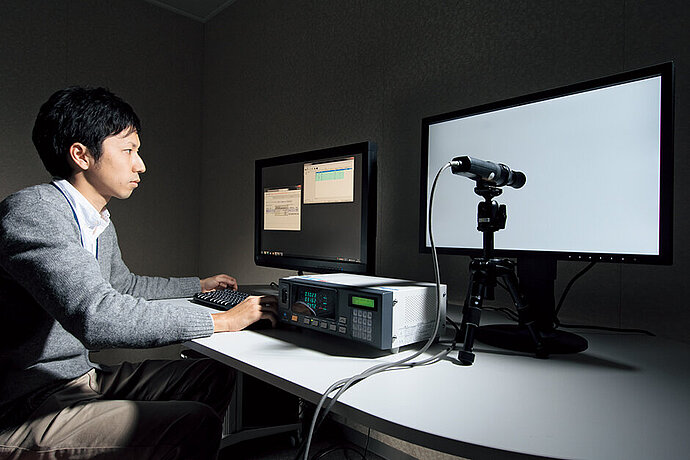
At the heart of Wischermann's image processing workflow are his ColorEdge monitors. In the office, Wischermann uses a ColorEdge CG3100X. In the home office and with his team there are ColorEdge CG2700Xs. Absolute precision is a must. Everything stands and falls with the reliable "reference view". "In my creative work, I don't want to have to ask myself whether what I see on the monitor really corresponds to the image file. I expect 100 percent from my tools. Only then can I concentrate fully on the retouching with a clear head," emphasizes Wischermann. Perfect calibration throughout the team, reproducible conditions, clear communication in correction loops – this is how "I like it" becomes a reliable "that's right".
ColorEdge monitors from the CG series deliver precisely this certainty. Reliable, reproducible and permanently stable without the need for additional maintenance. Thanks to the integrated calibration sensors, the CG ColorEdge monitors adjust themselves automatically at set intervals, ensuring a permanently stable display. "Thanks to the huge color space, I can reliably simulate all conceivable output formats and provide my customers with the perfect files for a wide range of applications," explains Wischermann. It doesn't matter whether it's an art print, packaging, large out-of-home campaigns or a web view.


Photo: Moja, Retouch Artist: Jan Wischermann,
Models: Laura Sanchez, Lohana Saby, Amelie Kammel, Lobke Leemans, Kasia Maria Smulska, Lauren Versnick
One such special production is the joint project Women and Cinema by photographer Moja and Jan Wischermann, which has been shown at the Cannes Film Festival for several years. The challenge of this project is to edit the images so that they look equally perfect unlit during the day and backlit at night on the large areas around the red carpet at the Hôtel Barrière Le Majestic.


Photo: Jessi Lang, Artist: Moja, Retouch Artist: Jan Wischerman
With USB-C connectivity, integrated LAN port and KVM switch, Wischermann's monitors also replace a complete docking station and create a flexible setup that can seamlessly switch between multiple computers. This creates a working environment that gives creatives exactly what they need: unadulterated reality – and the certainty that every detail is right.
Typical pitfalls in pre-production
Retouching can do a lot – but it should not take the blame for what could be avoided on set. Wischermann encounters three classics again and again:
- Wrong image selection: Emotion beats technique, and sometimes the selected image with the most beautiful facial expression is out of focus. "When blurry pictures come in, it's always a challenge – but you have to work with what you have."
- Styling negligence: "Let's do it in post" instead of removing it on location and suddenly there are countless wrinkles in the shirt to smooth out or areas in motion blur that are important to the image. This can be fixed, but it costs time and money.
- Incongruent light for composings: When selecting the background, model, light and perspective elements, care was not taken to ensure that everything fits together. This makes the adjustment unnecessarily time-consuming.
The fine line between optimization and falsification
Technology seduces. For Wischermann, "letting go" is therefore at least as important as "ability". He has therefore adopted a routine: "When I've finished retouching, I take it out completely and activate the individual work steps and increase their intensity. With skin, 50–70 percent often proves to be the sweet spot – enough to enhance, not enough to alienate. Less is often more. Especially in the hair area, not every hair is retouched these days. Flying hairs are allowed to stay." A counterweight to the all-too-smooth AI aesthetic.
Before – After


Photo: Per Appelgren, Retouch Artist: Jan Wischermann
Success factor
Early participation
Ideally, Wischermann is involved in the production process at an early stage. Preferably even before the shoot. That way, he can give advice that makes post-production easier. This is the case in the "Woman and Cinema" production: the elaborate shoots are already thought through the lens of the photographer and retouch artist during conception and preparation. The aim: a cinematic color grading that combines various motifs into a consistent series.
Where AI helps today – and where it has limits
Wischermann was automating repetitive tasks long before generative AI. Today, AI mainly takes on uninspiring tasks: Cleaning studio floors, removing stands, "clearing away" distracting elements. "AI is a savior here," says Wischermann happily. It also gets exciting when AI is used to explore ideas: trying out hairstyle variations, sketching out composing directions – "as a creative buddy", as he says. The final image remains a curated result. For him, legal clarity is non-negotiable – especially when it comes to commercial use, packaging or the use of virtual models. Tools must secure chains of rights, training data must be transparent; otherwise their use is taboo. However, customers' approach to AI is constantly changing.
The use of AI-generated image content or backgrounds is increasingly often requested. The use of AI models is also on the rise. "AI is not going away and it is radically changing the industry. The greatest weakness of AI and at the same time the greatest strength of humans is being creative, breaking rules and creating something new," explains Wischermann and continues: "AI is based on training data and probabilities. It doesn't create anything new. Instead, it mostly reproduces the old. I am sure that AI will continue to simplify or even replace processes in the future. But it cannot replace human creativity (at least not yet)".
Looking ahead
Modular creative workflow
While generative AI models are shaking up the industry, Wischermann is particularly interested in the next layer shift: modular, node-based creative workflows in which images, video, 3D and compositing steps can be flexibly combined and provided as small "apps". However, one principle remains decisive for him: Idea first – tool second. "I have stopped immersing myself in every new feature or tool down to the last detail. After a short time, there are often new tools that can do everything much better," summarizes Wischermann and adds: "It's about having a clear idea and vision first – and then selecting the right tool."
Conclusion
Jan Wischermann stands for retouching that you can't see - which is precisely why it works. His work shows how closely craft, the psychology of perception and brand understanding are intertwined. Between perfection and character, automation, manual work, control and trust, he navigates a course that does not "correct" images, but completes them. Or, as he puts it himself: "A good retouch artist orchestrates luminance, color and saturation so that the vision of the creative and client results in an image that tells the right story."

Jan Wischermann
Jan Wischermann is a high-end retouch artist from Düsseldorf specializing in hair and beauty campaigns. With his studio Jan Wischermann Imaging, he works for international clients in the hair and beauty industry as well as for magazines such as Vogue and TUSH and supports photographers and creative teams in the realization of high-quality campaign and editorial productions. He is also the founder of The Curated Lab, an international growth platform for creatives in the fields of photography, retouching and art direction with access to curated industry knowledge, leading minds in the creative industry and a select peer community.
Website | Instagram | LinkedIn | The Curated Lab