Massimo Balestrini is an artist who has been exploring various forms of expression and media for years, moving between painting, drawing, digital image processing, and, more recently, artificial intelligence.
His research stems from the intersection of artistic training and computer skills. In this hybrid realm, manual practice enters into a dialogue with technological processes, and the image becomes a space of transition, memory, and constant transformation.
ColorEdge Case Study
Massimo Balestrini
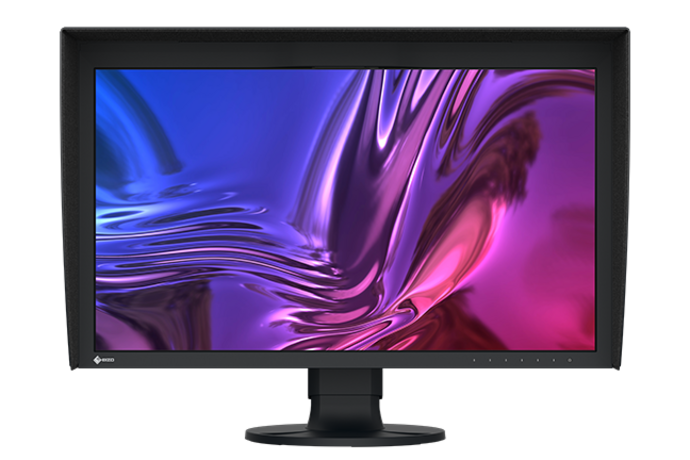
The artist and instructor is impressed by the ColorEdge's precision and color accuracy.

His work focuses on visual layering, the collective imagination, and the persistence of images over time. Photographs, fragments of popular culture, pictorial symbols, digital traces, visual archives, and generative systems interact in an open process in which the work never presents itself as a final form, but rather as an unstable surface permeated by deposits, interferences, and reappearances.
A central aspect of his research concerns the transition from the digital image to the physical presence of the work. The print, the ink, the substrate, the light, and color management become crucial elements of this transition. In the transfer from the screen to the physical surface, the image changes its state: it loses its apparent immateriality and gains physicality, depth, and resilience. At this threshold between digital data and visual presence, Balestrini explores the perceptual possibilities of contemporary artworks.
In parallel with his artistic practice, Balestrini is a dedicated lecturer at the Academy of Fine Arts in Verona, where he teaches painting and digital image processing. In this context, he guides students toward a conscious approach to digital and professional tools—not merely as operational aids, but as active languages capable of penetrating to the core of the creative process.
He has also carried out projects in collaboration with the University of Milan, focusing on research into artificial intelligence and the intersection between art, digital technologies, and various disciplines.
His work thus operates at an intersection: between painting and the digital realm, between individual memory and collective imagination, between matter and algorithms. It is a practice in which the image is not merely produced, but is continually traversed, rewritten, and questioned.

What is important to you when you create your works?

For me, a work of art never arises from a single gesture, nor even from a single language. Rather, it emerges from a series of intersections: images I collect, personal and collective memories, references to popular culture, photography, painting, digital printing, and, in recent years, even artificial intelligence systems. I’m interested in the moment when these materials cease to be separate elements and begin to generate visual tension.
The challenge—if you want to call it that—lies in maintaining an open relationship between control and the unexpected. Digital technology allows for enormous precision, yet there is a danger that everything will become too closed off, too smooth. Painting, on the other hand, brings time, the body, mistakes, and surface into play. My work seeks a balance between these two poles: on the one hand, the construction of the image through code, collage, generation, and print; on the other, the need to restore the image to a physical, material, multi-layered presence.
So when I work creatively, I’m not simply looking for a beautiful image: I’m looking for an image that carries memory within it, that preserves traces of the creative process, and that allows the viewer to enter a realm that is not fully resolved.
Why did you choose ColorEdge?
In my work, color management is not a technical detail, but rather part of the creative process. Many works go through several phases: digital editing, proofs, visual interventions, new shots, or photographic documentation—and often further revisions. If the monitor isn’t reliable during this process, the image’s identity constantly changes. There’s a risk that what I see on the screen won’t match the print, which leads to subsequent visual decisions being less precise.
I’ve been working with EIZO monitors for over twenty years because I need a stable, consistent, and professional tool for image editing. For me, it’s not just about having a bright or appealing image, but also about being able to accurately assess tonal transitions, shadows, dominant colors, and the differences between closely spaced areas. For an artist who combines digital technology and painting, this precision is crucial: it enables more informed decisions before printing or making manual adjustments.
In this sense, the monitor is not, for me, an element separate from the work, but rather part of the creative process. It is the point at which the digital image is viewed, reviewed, and prepared to become a tangible work of art.

Tell us about your experiences with ColorEdge monitors.
The most important insight is the ability to work with a consistent visual case study. When working on complex, multi-layered images, general color control is not enough. You have to be able to detect subtle variations, understand whether a transition is too narrow, whether a dominant color is altering the atmosphere, and whether an area should be toned down or made to stand out more.
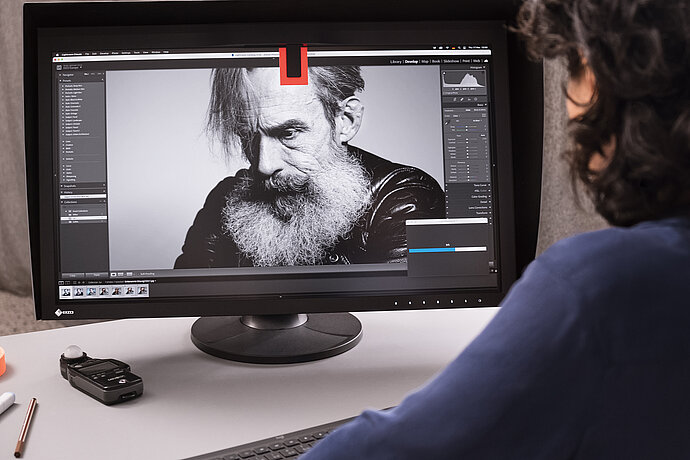
The ColorEdge monitor plays a key role in my workflow. During the review and decision-making phases, I use it to check the image before printing, evaluate the balance between digitally generated elements and artistic interventions, and ensure consistency between what appears on the screen and what ultimately becomes the physical medium. This is particularly important when the work combines painting, photography, digital printing, and images generated or transformed using artificial intelligence.
The monitor’s precision also helps me in my teaching. At the Academy of Fine Arts in Verona, I teach painting and digital image processing and coordinate the three-year “New Art Technologies” program. With the students, it’s not just about learning how to use software, but about understanding the entire image-making process: calibration, color, printing, and the relationship between digital image processing and manual intervention. In this sense, professional tools allow us to concretely demonstrate that image quality depends on well-informed decisions throughout the entire process.

What is your message to young artists?
I would advise them not to be too quick to separate technology from imagination. Any tool, even the most sophisticated one, remains useless if it serves only to create effects. At the same time, there’s no need to be afraid of technology: digital technology, printing, artificial intelligence, and color management can become spaces for authentic exploration if approached with awareness.
I would advise a young artist to thoroughly master the tools, but never to identify with them. It is important to master the technology, to calibrate a monitor, to understand colors, and to know what happens when an image transitions from the screen to print. All of this, however, must serve the purpose of developing a personal perspective.
Art often emerges in a zone of friction: between control and the unexpected, between memory and invention, between mental imagery and matter. Professional tools help to clarify this transition, but the artist’s task remains to imbue images with meaning—not merely to produce them.

CONCLUSION
In Balestrini’s work, chromatic precision becomes part of a broader process in which painting, digital printing, visual memory, and new technologies continuously interact with one another. It is precisely in this transition between the intangible image and the physical work that tools such as EIZO’s ColorEdge monitors play their most important role: they help the artist better perceive what he is creating.